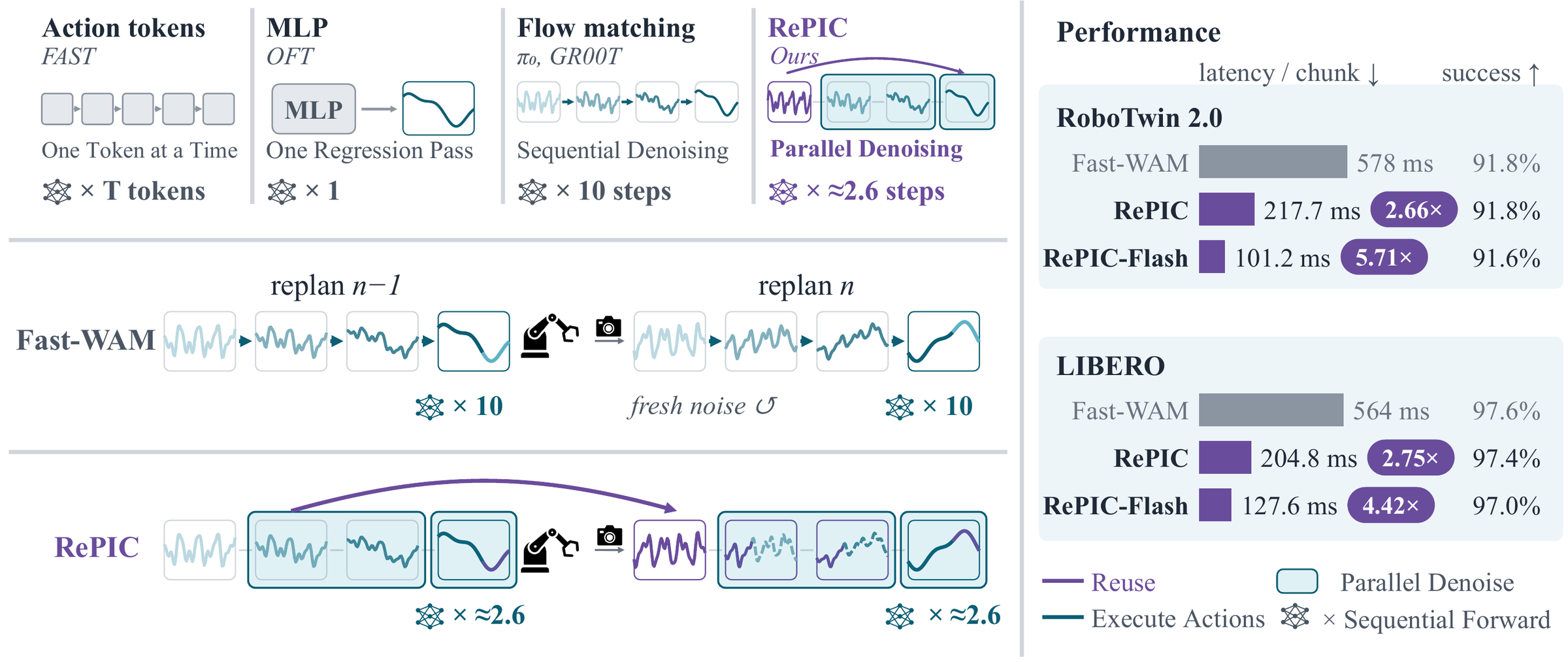
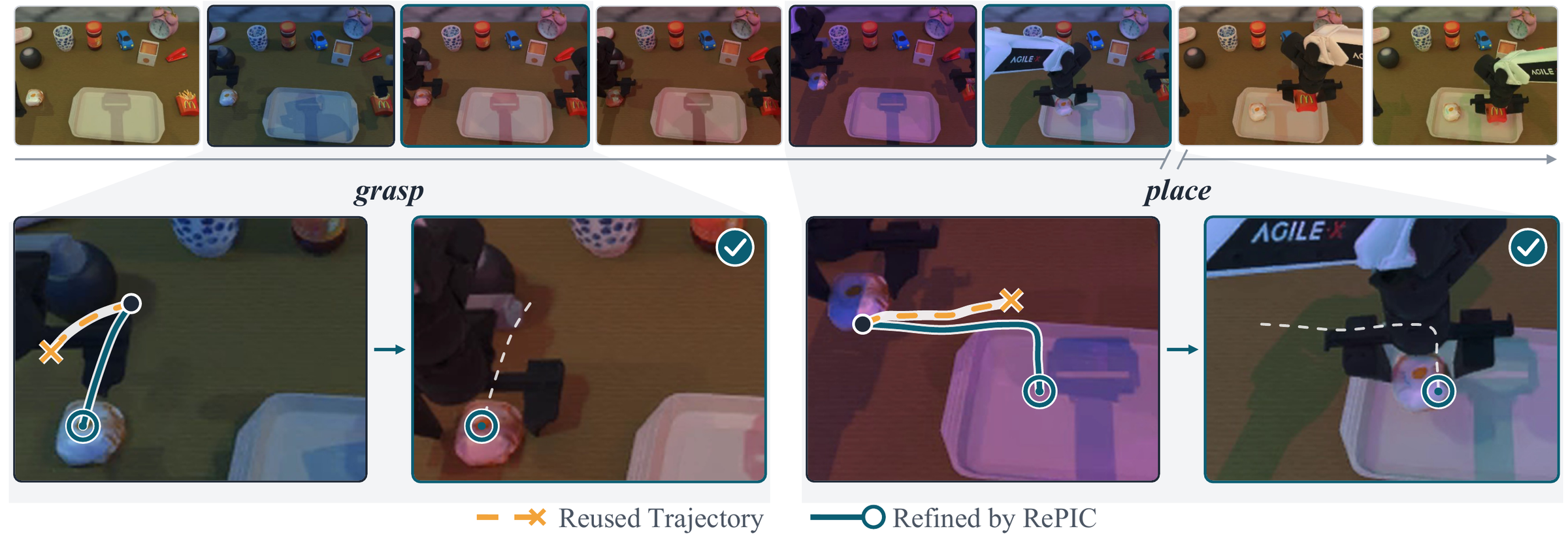
A flow-based robot policy denoises every action chunk from scratch and discards the solver trajectory at the next replan, although consecutive replans solve nearly the same problem. RePIC keeps it: shift it to the new horizon, re-align it to fresh noise in closed form, and let the pretrained network refine all states at once. Sequential calls per chunk drop from 10 to about 2.6.
Reuse the solve, then refine it in parallel
One replan: transfer, refine, execute
-
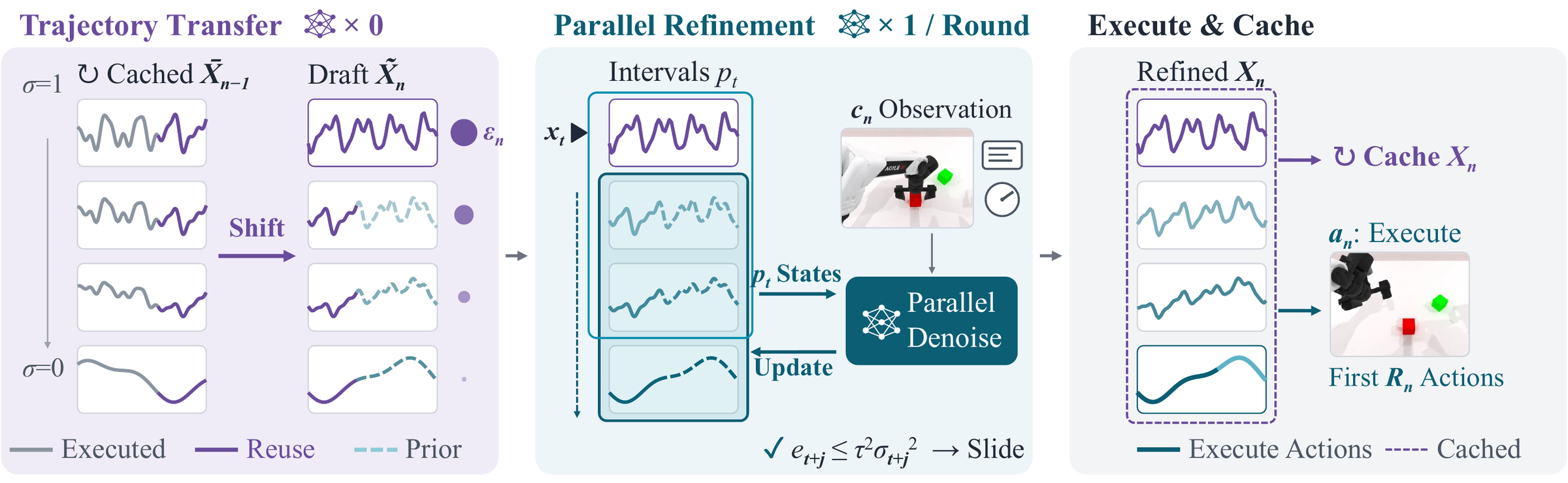
Trajectory transfer
Shift the cached trajectory by the executed prefix Rn−1 and re-align it to the fresh noise εn.
0 network calls
-
Parallel refinement
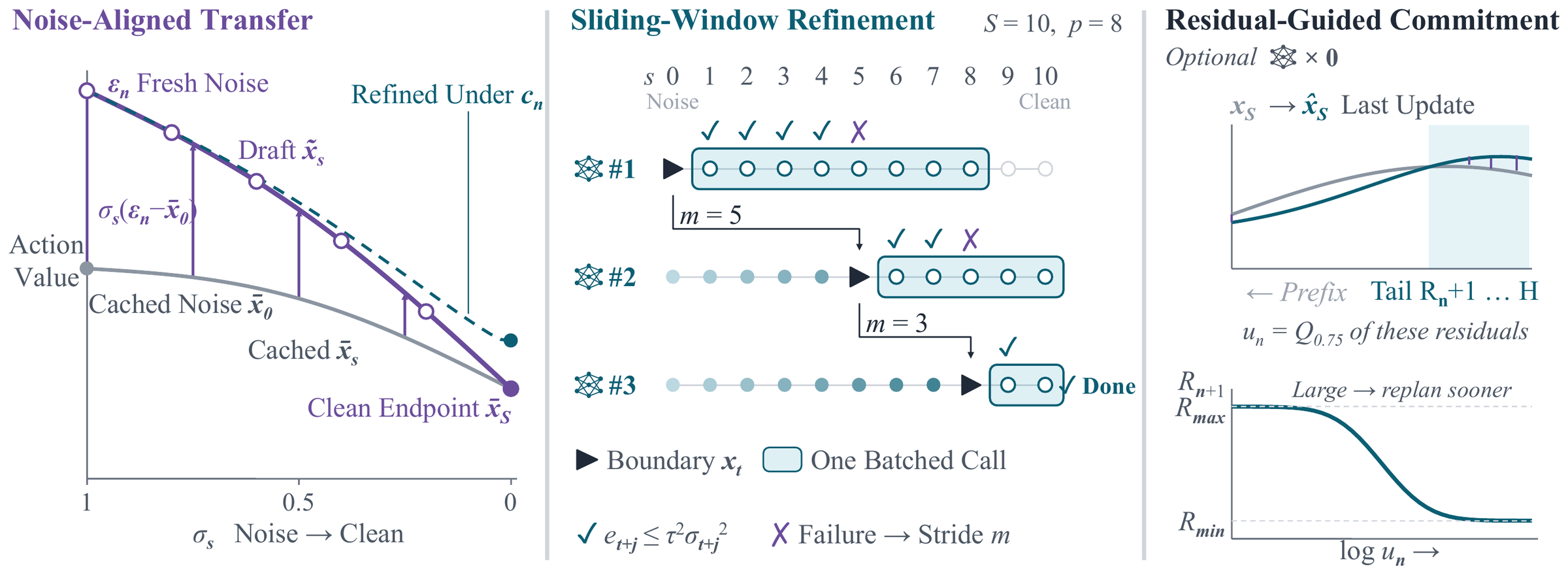
Refine a sliding window of p steps with batched fixed-point (Picard) updates. It advances by the longest stride whose residual on the executed prefix stays under τ2σ2.
1 batched call per round
-
Execute and cache
Execute the first Rn actions and cache the refined trajectory. Optionally, the tail residual picks the next execution length.
0 network calls
Noise-aligned transfer
Eq. 7 x̃s,h = x̄s,q(h) + σs ( εn,h − x̄0,q(h) )
Here q(h) maps position h to the matching step of the previous chunk. At σ = 1 the draft is the fresh noise; at σ = 0 it keeps the cached clean actions.
Try the transfer
Step through the noise levels and switch the alignment off to see what shifting alone leaves behind.
Illustration with synthetic curves, horizon H = 32, computed with Eq. 6–7 and the S = 10, shift 5 schedule.
A reused trajectory starts close to the answer
On a RoboTwin 2.0 rollout, the 8 steps carried over from the previous chunk start 24× closer to the serial solution than a cold draft, and the remaining positions 4.4× closer. A closer draft means smaller residuals, longer strides and fewer calls.
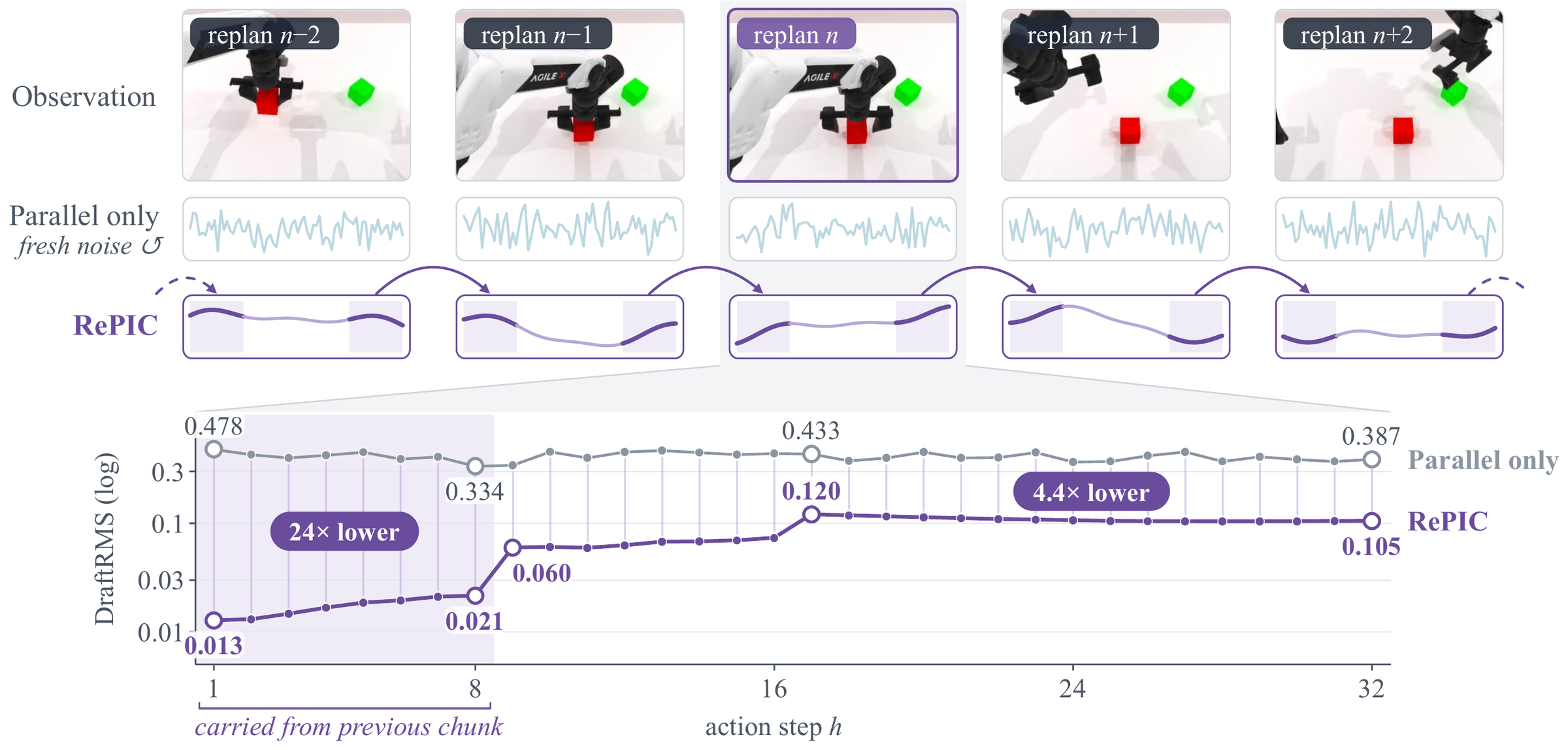
Reuse only initializes: every refinement round re-evaluates the velocity field under the current observation.
Faster at comparable success
Latency drops 2.66× on RoboTwin 2.0 (91.8% success, unchanged) and 2.75× on LIBERO (97.55% to 97.35%). The same sampler gives 1.14× on π0.5 and 1.68× on GR00T N1.5 without retraining.
Full results on RoboTwin 2.0
| Method | Size | Clean | Random | Avg. | Latency (ms) | Speed (×) |
|---|---|---|---|---|---|---|
| LingBot-VA | 5.3B | 92.9 | 91.6 | 92.2 | 9356.00 | 0.06 |
| Motus | 8.0B | 88.7 | 87.0 | 87.8 | 2177.00 | 0.27 |
| Fast-WAM (Joint) | 6.0B | 90.8 | 90.3 | 90.6 | 1122.00 | 0.52 |
| Enfold | 3.0B | 91.6 | 91.9 | 91.8 | 253.00 | 2.28 |
| ImageWAM | 8.6B | 93.2 | 93.6 | 93.4 | 351.00 | 1.65 |
| Faster-WAM (FC) | ~6B | 92.8 | 92.3 | 92.6 | 493.00 | 1.17 |
| AHA-WAM | 7.23B | 93.4 | 92.2 | 92.8 | 535.50 | 1.08 |
| Faster-WAM (DoT) | 5.05B | 89.7 | 88.6 | 89.2 | – | – |
| Fast-WAM | 6.0B | 91.9 | 91.8 | 91.8 | 578.00 | 1.00 |
| C3ache | 6.0B | 91.0 | 89.7 | 90.4 | 314.13† | 1.84 |
| RePIC | 6.0B | 91.9 | 91.7 | 91.8 | 217.70 | 2.66 |
| RePIC-Flash | 6.0B | 92.4 | 90.7 | 91.6 | 101.16 | 5.71 |
Success rate in %. Speed is relative to Fast-WAM. † Inferred from the reported speed-up and the reference latency.
Full results on LIBERO
| Method | Size | Spatial | Object | Goal | Long | Avg. | Latency (ms) | Speed (×) |
|---|---|---|---|---|---|---|---|---|
| Vision-language-action models | ||||||||
| SmolVLA | 0.45B | 90.0 | 96.0 | 92.0 | 71.0 | 87.25 | 239.00 | – |
| π0.5 | ~3.35B | 98.0 | 98.6 | 96.8 | 90.8 | 96.05 | 70.24 | 1.00 |
| π0.5 + RePIC | ~3.35B | 97.6 | 98.2 | 96.0 | 91.2 | 95.75 | 61.35 | 1.14 |
| GR00T N1.5 | 3.0B | 89.0 | 91.4 | 88.8 | 78.4 | 86.90 | 120.62 | 1.00 |
| GR00T N1.5 + RePIC | 3.0B | 90.0 | 93.2 | 90.4 | 79.0 | 88.15 | 71.60 | 1.68 |
| World action models | ||||||||
| LingBot-VA | 5.3B | 98.5 | 99.6 | 97.2 | 98.5 | 98.45 | 8623.00 | 0.07 |
| Fast-WAM (Joint) | 6.0B | 99.6 | 99.4 | 98.2 | 96.8 | 98.50 | 1146.00 | 0.49 |
| Enfold | 3.0B | 97.0 | 100.0 | 96.8 | 97.4 | 97.80 | 268.00 | 2.10 |
| ImageWAM | 8.6B | 97.0 | 99.4 | 98.2 | 96.8 | 97.85 | 373.00 | 1.51 |
| Faster-WAM (FC) | ~6B | 98.8 | 100.0 | 98.4 | 97.2 | 98.60 | 488.00 | 1.16 |
| Faster-WAM (DoT) | 5.05B | 98.4 | 100.0 | 97.0 | 97.8 | 98.30 | 176.20† | 3.20 |
| Fast-WAM | 6.0B | 98.0 | 99.6 | 97.2 | 95.4 | 97.55 | 563.85 | 1.00 |
| C3ache | 6.0B | 97.6 | 99.6 | 96.0 | 95.2 | 97.10 | 224.64† | 2.51 |
| RePIC | 6.0B | 97.4 | 99.6 | 96.8 | 95.6 | 97.35 | 204.77 | 2.75 |
| RePIC-Flash | 6.0B | 97.4 | 99.4 | 96.4 | 94.8 | 97.00 | 127.63 | 4.42 |
Success rate in %. Speed is relative to the same backbone (VLAs) or to Fast-WAM (WAMs). † Inferred from the reported speed-up and the reference latency.
What each part buys
Ablations on LIBERO with Fast-WAM; a batched call counts as one sequential call. Parallel refinement alone cuts calls from 10 to 4, and reuse brings them to 2.22.
| Method | S | Success | Calls | ms |
|---|---|---|---|---|
| Baseline | 10 | 97.55 | 10.00 | 563.85 |
| Baseline | 5 | 96.90 | 5.00 | 333.00 |
| Baseline | 3 | 96.60 | 3.00 | 236.30 |
| Baseline | 1 | 95.35 | 1.00 | 151.80 |
| Parallel only | 10 | 97.10 | 4.00 | 298.10 |
| RePIC | 10 | 97.35 | 2.22 | 204.77 |
| Draft | Shift | Align | Success | Calls | ms |
|---|---|---|---|---|---|
| No reuse | – | – | 97.10 | 4.00 | 298.10 |
| Endpoint only | ✓ | – | 97.05 | 2.88 | 234.70 |
| Full trajectory | ✗ | ✗ | 96.35 | 3.03 | 245.80 |
| Full trajectory | ✗ | ✓ | 96.40 | 3.01 | 243.90 |
| Full trajectory | ✓ | ✗ | 97.15 | 4.87 | 331.40 |
| RePIC | ✓ | ✓ | 97.35 | 2.22 | 204.77 |
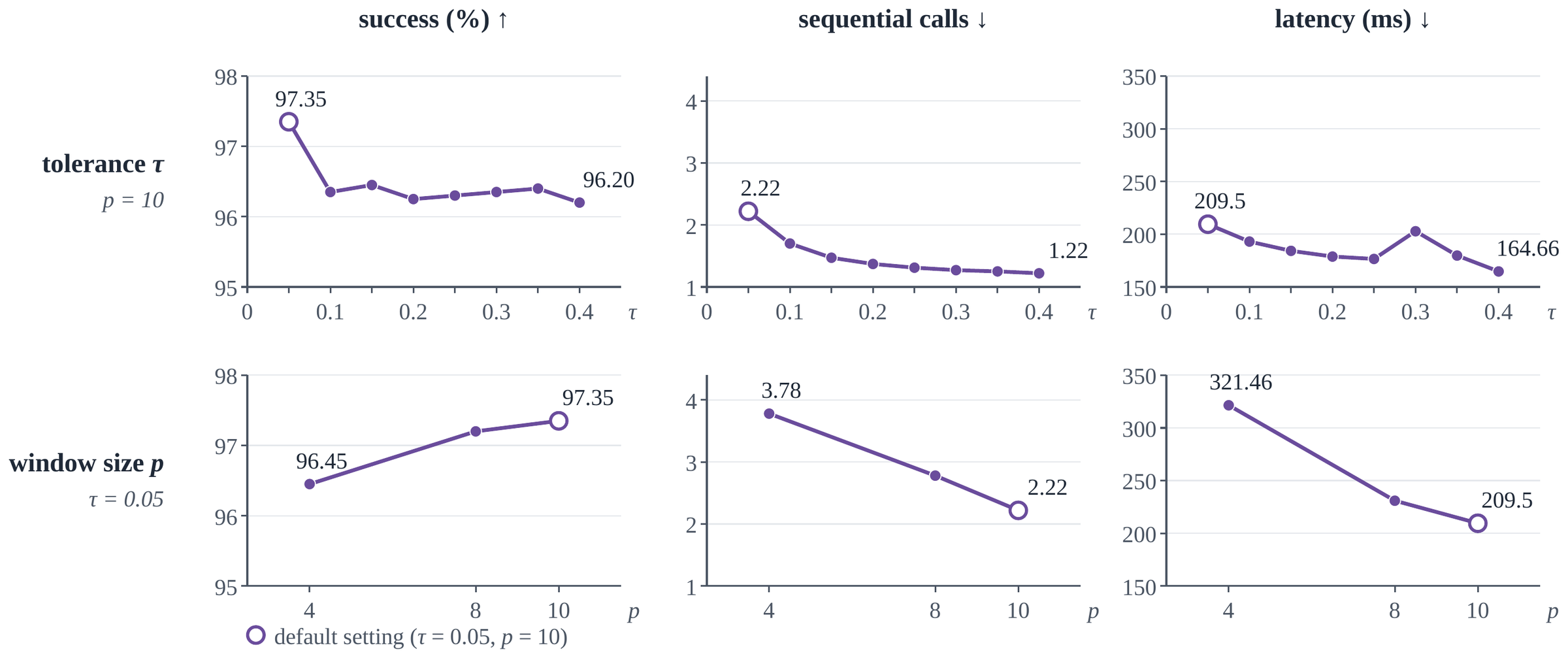
RePIC applies to deterministic flow samplers whose states at different noise levels can be batched. It trades batched compute and memory for a shorter sequential path.
On a real robot and in simulation
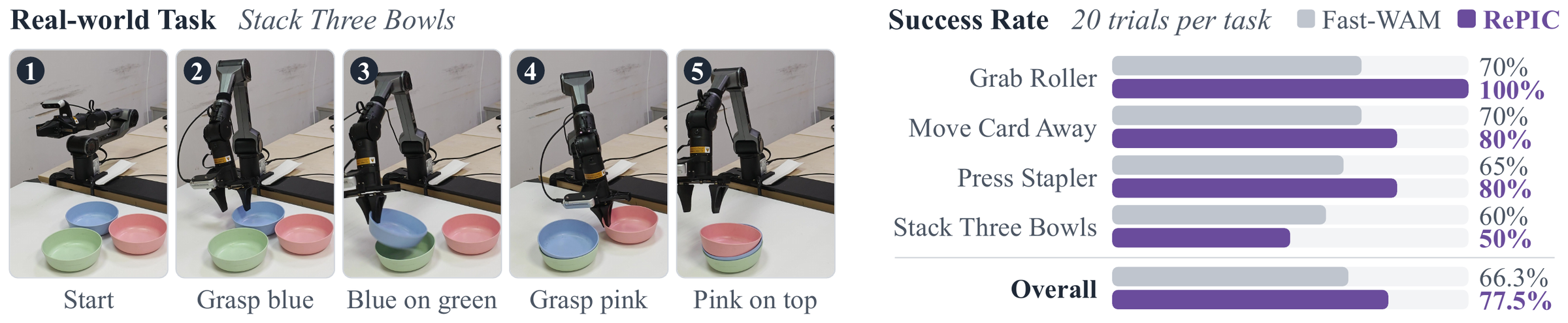
We run Fast-WAM with and without RePIC on an Agilex Piper arm. RePIC succeeds in 62 of 80 trials (77.5%) versus 53 (66.3%), with higher success on three of four tasks. At 20 trials per task, the differences are within trial-to-trial variation.
Fast-WAM (left) and RePIC (right), real time.
Grab Roller
Fast-WAM
RePIC
Success over 20 trials: 70% → 100%
Move Card Away
Fast-WAM
RePIC
Success over 20 trials: 70% → 80%
Stack Three Bowls
Fast-WAM
RePIC
Success over 20 trials: 60% → 50%
Each clip is a single trial. The fourth task, Press Stapler, went from 65% to 80%.
RoboTwin 2.0 rollouts
Head-camera view of successful rollouts.
Cite RePIC
@misc{wu2026repic,
  title={Don't Throw Away the Solution: Reusing Denoising Trajectories for Fast Robot Control},
  author={Xianjin Wu and Xian Li and Jianxiang Tang and Dingkang Liang and Xiang Bai},
  year={2026},
  note={Preprint}
}
The main branch is built on Fast-WAM; please cite it as well.